Blog 18 Frankfurt

What does it mean to be a person, according to Frankfurt?

To be a person according to Frankfurt one must be able to possess a second order desire or second order volition. He recognizes that humans are not the only creatures to possess the ability to want / have desires, but we are the only ones that “are capable of wanting to be different in, their preferences and purposes,” (7, Frankfurt).

Explain the order of desires, and how they are related to freedom of will.

There are two types of desires first order desires and second order desires. First order desires which are present in animals and it is presented as “… wanting and choosing and being moved to do this or that… also want to have (or not to have) certain desires and motives,” (7, Frankfurt). This can be put simply as desires to do or not to do. Next are Second order desires, within the branch of second order desires is the second order volition, this is the thought that I want this desire to be (or not be) effective. Being able to think of these different levels of desires is essential to being a person to Frankfurt, but what if someone has “second-order desires but with no volitions of the second order,” (11, Frankfurt)? To Frankfurt this creature would not be considered a person and will now only be referred to as a “wanton” (11, Frankfurt).

Give your own examples of each order of desire.

First order desire: I want to get into UC Davis.

Second order desire: I want to want to be good at the math required for a chemistry major.

Second order volition: I want to graduate from UC Davis with a bachelors of science in biochemistry.

Is this a useful way to understand freedom? Are you currently free, according to Frankfurt’s definitions?

According to Frankfurt yes, I am free because my first order desires match my second order volition. Under Frankforts philosophy a person is free if he is able to “enjoy both freedom of action and freedom of the will. Then he is not only free to do what he wants to do; he is also free to want what he wants to want. It seems to me that he has, in that case, all the freedom it is possible to desire or to conceive. There are other good things in life, and he may not possess some of them,” (17, Frankfurt). A part of me thinks that this is a pretty good way to understand freedom because if you want or desire to do something and you are working towards it and your whole life revolves around said desire or want then you are understandably free since your feelings coincide with your actions. On the other hand I don’t think it is true freedom because every moment is being spent on working towards achieving your desire or want and the thought that just maybe if your feelings and actions don’t flow together then you’re automatically considered not free, I think that if there was more wiggle room to his definition of freedom then it would be perfect but since there isn’t then it is not perfect only just “ok”.

word count: 536
source: https://thinkingbeings.files.wordpress.com/2015/08/freedom-of-the-will-and-the-concept-of-a-person.pdf

Blog prompt 16 MacIntyre

Prompt: choose a passage from the MacIntyre reading that describes a particular aspect of persons as the subject of a narrative. Quote the passage, explain it, and tell a specific, personal, life experience that illustrates its significance with respect to identity (your identity)

“I am the subject of a history that is my own and no one else’s, that has its own peculiar meaning,” (MacIntyre, The Storytelling Animal).

In this passage MacIntyre is stating that the subject “I” is the main character in their own personal narrative. This narrative is the subjects history, this history is full of all of the experiences and learning opportunities that the subject has gone through. This history is unique to only the subject since it has shaped them into the person they are now and will be in the future; therefore creating its own special meaning to the main subject. This means that under MacIntyre’s philosophy everyone has a meaning and purpose for existing, and that we all have a role to play in life based on our own special history so that we may contribute to something outside of ourselves.

For me the passage I chose stuck out and caught my attention making me feel a “Yes! I agree!!” moment that stuck with me even after I finished reading. I think that my story, in particular, is kind of a special case for MacIntyre’s philosophy since I, personally, cannot remember a lot of my past. I really only know bits and pieces of it and I ask those around me about it with no luck in remembering it; in the end I mainly just end up thinking I do not want to be the embodiment of the experiences that I have blocked out. Even though I am unable to pin point the actions that make me feel this way or am able to remember my entire history I have the capability to know what I should try and stay away from and what I should head towards in order to be the person I want to be. With all things considered, I agree with MacIntyre. I think his philosophy as to how and why people are the way they are is true and it makes sense without beating around the bush. Ones history creates the past and it helps determine ones future as well whether it be good or bad. It is solely up to the owner of the experiences to turn a bad situation into a good one or to let it consume them and become exactly what they went through.

word count: 433

source: https://thinkingbeings.files.wordpress.com/2015/08/storytelling-animal.pdf

Blog on Memento

Prompt: Leonard relies upon scribbled notes to connect him to his past. He says that eyewitness testimony is worthless: “Memory can change the shape of a room…” Is he right? Do you think our memories are more reliable than his notes? Hume says identity is just a habit we have. Do you think Hume would see Leonard’s condition as any different from our own?

“Memory can change the shape of a room…” from personal experience I have no other choice than to agree with Leonard’s statement. In life our past experiences and the emotions connected to those certain experiences and memories can cause us to respond in either a positive or negative way. These emotional responses have the ability to shape our memories of an entire situation in such a way that the whole memory can reflect the emotions we felt in that moment. With this being said I do believe that memories are more reliable than a note or even someone else’s view on the same experience. In my own life I have trouble remembering certain parts of my life and I would have to say that just using some little memento or photograph to remember everything is pretty difficult. It is hard to tell if a certain photograph can tell you the story of an entire day or segment of your life, photographs are easily manipulated and changed to a point where they can tell an entirely different story. A perfect example of this is from a scene near the end of the movie where Leonard burns a photo, manipulates his notes, and essentially creates a whole new narrative for his life to follow. I think Hume wouldn’t see Leonards condition as any different than our own because Hume states that “identity is nothing really belonging to these different perceptions, and uniting them together, but is merely a quality, which we attribute to them, because of the union of their ideas in the imagination, when we reflect on them,” (Hume, 325-326). Leonard has his past memories and he has his photos that act as memory fillers which he reflects on daily to keep them fresh in his head. He also has the ability to separate specific memories that he made and turn those memories into a whole other person named Sammy giving him an entire made up narrative that for all we know is only real to Leonard and everyone he tells.

word count: 406

source: https://thinkingbeings.files.wordpress.com/2015/08/hume-on-id.pdf

Blog prompt 12 (presentation)

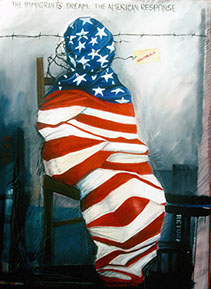
An Immigrant’s Dream, the American Response, Acrylic on canvas, 2003 Malaquias Montoya

http://www.malaquiasmontoya.com/gallery-paintings.html

An Immigrant’s Dream, the American Response is a painting by Malaquias Montoya, a famous California artist most known for his Chicano artwork. Somethings to note about this piece in particular are, starting from the top and working our way down to the bottom, is the red dripping down from the top as it looks like blood, next is the title of the piece up top, underneath said title is barbed wire wrapped around the individuals head (barbed wire is common imagery in Montoya’s artwork), on the barbed wire is a tag/label that reads “undocumented”, lastly is quite obviously the individual being bound in the American flag. I believe An Immigrant’s Dream, the American Response qualifies as art because it fit’s into Tolstoy’s standards as follows:

  1. “On the greater or lesser individuality of the feeling transmitted,” (line #30). This specific piece from Montoya gives off a feeling of pain and suffering, but not pain that you can feel it’s one that you see, almost like watching someone else fall or get hurt. This art is, for lack of a better word, strong; this can be inferred because somehow without even seeing a face or any actual person the agony and sorrow felt by the subject is translated to the observer. Personally, I’ve never seen art that has moved me in such a way where I am physically uncomfortable and almost scared to look at it, yet at the same time I am unable to take my eyes away because I want to see and understand more.

2. “On the greater of lesser clearness with which the feeling is transmitted,”( line #30). Malaquias Montoya is best known for his controversial art pieces that contain reoccurring imagery of barbed wire. After studying his work and knowing him personally it can be inferred that the barbed wire in Montoya’s pieces are used to convey involuntary silencing and restraint in turn stripping the subjects away from their own free will. In this specific art piece the sentence on top reads “the immigrants dream, the American response” this tied in with the imagery of a person bound with the American flag, with barbed wire around their head, and the tag “undocumented” on it leads me to believe that this person no longer has any control and is reduced down to only being a title with a little too much control. There is no special way to look at this painting to know all of this information (besides the barbed wire piece), all of these images are put in plain sight and act as a four piece puzzle that leads to the second hand feeling of anguish.

3. “On the sincerity of the artist, I.e., on the greater of lesser force with which the artist himself feels the emotion he transmits,” (line #30). Malaquias Montoya is a man from New Mexico who was raised in California in family of farm laborers. Malaquias has always focused his art as being a form of protest, “depicting the resistance and strength of humanity in the face of injustice and the necessity to unite behind that struggle,” (malaquiasmontoya.com). Montoya has a deep root in fighting for justice and has always been a figure that feels strongly for the people without a voice as he himself was born into a silenced community.

I would say that I do agree with Tolstoy’s definition and view on what art is, but what I do have to say is that it is kind of hard to understand the sincerity of an artist if you don’t know the artist’s backstory. I believe that interpretation of art can change from person to person based on their own paths, therefore to me this is art even if it is kind of hard to put into three categories. One thing for certain is all art carries emotion and some artwork present’s its feelings stronger than others. This strength in emotion can have a direct effect on it’s infection “The stronger the infection, the better is the art as art, speaking now apart from its subject matter, i.e., not considering the quality of the feelings it transmits,” (line #29).

word count: 700

sources: http://www.malaquiasmontoya.com/malaquias-montoya-about.html http://web.csulb.edu/~jvancamp/361r14.html

Blog prompt 11 – What is Art?

Tolstoy uses the test of infectiousness, not only as a descriptive measure for what should count as art, but also as a standard for good art (#28-32). What does he mean by this standard? How does he suggest we apply this test to evaluate art? Is this a useful proposal for evaluating the quality of art? If you disagree with this proposal, how would you challenge it?

Tolstoy defines art as a form of communication, this means that there is an equal understanding of emotions flowing between an artist and any observer that comes across said art. Tolstoy has a belief that true art is any work that is able to invoke a strong emotion and unite people solely based on shared emotions, this means that the art itself should be made with the idea in mind that it allows for an outsider to be able to easily understand and feel another persons emotions without any extra actions needing to be done. After Tolstoy explains his definition of art and how people with different backgrounds feel towards it he begins to bring up the term “infectiousness” quite often (this starts at about line 25). His use of this word allows for him describe the effect (internal and external) art has on an individual after encountering it, and the level of infectiousness also, in someway, determines how great the artwork is and if the art is even “real” or not. This is seen in line 29 where he states that “The stronger the infection, the better is the art as art,” (Tolstoy, line 29). Now, to make life easier for us Tolstoy goes on to break down what three conditions an art piece must contain to be considered infectious, “#30. And the degree of the infectiousness of art depends on three conditions:

  1. On the greater or lesser individuality of the feeling transmitted;
  2. on the greater or lesser clearness with which the feeling is transmitted;
  3. on the sincerity of the artist, i.e., on the greater or lesser force with which the artist himself feels the emotion he transmits.” (Tolstoy, line 30).

Through this guideline one is able to interpret that if a piece of art contains all three of these conditions it is art, and if each condition feels sincere and is clearly represented the better the art is at being art. But, if a so called art piece does not contain one of the three conditions it is labeled as a counterfeit and is presumed to be “…not a work of art,” (Tolstoy, line 37).

Art in the eyes of Tolstoy must have an effect on someone. His suggestion is that if an individual can clearly feel the intensity of an emotion being portrayed in a unique way by an artist it is something that would be considered art regardless if the emotions coming from the art are positive or negative. But if one does not feel any emotion or movement from a piece and remains indifferent it now has no meaning and is considered not art. Tolstoy’s proposal for evaluating the art is good, sadly it lacks understanding that everyone interprets objects in their life differently due to personal experience. I also believe that art can be good and have absolutely no meaning behind it, an example of this is the unimaginable amount of paintings of fruit, their only purpose is to show off the artist’s understanding of shading and light to make things look realistic.

Lastly, if I were to change Tolstoy’s proposal I would make it into one that acknowledges people’s backgrounds and am understanding of how their pasts effect how their perceive and interpret art in the world around them.

word count: 610

source: http://www.csulb.edu/~jvancamp/361r14.html

eXistenZ and Plato

How does Existenz, the film, fit into Plato’s hierarchical scheme of reality?

Existenz, the film, fits into Plato’s hierarchical scheme of reality because in the film we are tossed into what’s assumed to be three levels of reality, just like in Plato’s ideas. The three levels of reality in Existenz, film, follow as the real world, the first game trancendenz, and the second game existenz, this coincides with Plato’s levels being reality, physical, art. In the movie the real world is the reality, the game trancendenz is the physical, and existenz is the art.

My take on the film:

The film talks a lot about reality as the games themselves are designed to take the user out of reality and liberate them from their normal lives by allowing them to make a new one. Throughout the movie there are scenes that don’t fit what we define as normal, a few examples of this is to play the game existenz you have to have this thing called a bio-port installed which is a direct opening into your spinal cord, next is the game console itself the console is this hybridized creature that’s appears to be part flesh and part technology, after that is the fact that other objects are fleshy technology like their cellphones and the creatures are said to be “two headed amphibians”, lastly is the fact that in the “real world” things are labelled blankly on buildings which to some degree is different from our real world. Along with those strange scenes a few lines stick out, the game design is described to be “like real life just enough to make it more interesting”(eXistenZ), after starting and exiting the game existenz Ted states that “real life doesn’t feel real after the game” and that there is an “element of psychosis in game,” with a response from Allegra where she says that it “means it’s working,” (eXistenZ). I think that the quotes and strange objects are put in place to make the viewer either question if that is truly the real world or something else, but it is then revealed that Allegra and Ted we in fact playing a game within a game allowing for the viewer to understand why certain things were so abnormal.

How does the game, Trancendenz fit?

The game trancendenz fits into Plato’s hierarchical scheme of reality by being the “physical world” because from the beginning of the film to about a quarter of the way to the end the viewer is sheltered from what their “real world” is and have no other excuse than to assume that it’s just a tad bit different from what our view of the real world is. The film’s genre is also sci-fi so in a way it makes sense to not question the reality of things. By the end of the film it is revealed that existenz is a game within a game called trancendenz. For me to personally understand the movie and relate it back to Plato I have to look at it in layers; the outermost layer is reality, or the real wprld, next is the game trancendenz which is the physical world/ creation, and existenz is the art/ the imitation.

word count: 542

all quotes from the movie eXistenZ

Blog Prompt 5

What is the difference between “beds in the world” and “the idea of a bed?” Where does “art” fit into his hierarchical scheme of reality? Plato criticizes art for being “deceptive.” How does art deceive us, according to Plato? Do you agree with this criticism?

The difference between “beds in the world” and “the idea of a bed” is that the idea of a bed is what makes it real because they all have their own distinguishable characteristics, with the understanding that not every bed is the same and that everyone has their own thoughts on what a bed is. Next, is a bed in the real world; beds in the real world is the concept of a bed and is essentially to an object that does everything a bed does without being an actual bed, by actual bed I mean what pops into our head when we think of a bed. These are from Plato’s The Republic: Book X where he discusses the fact that in life there are three artists; “God, the maker, and the artist” (Plato). In this he claims that God is the creator who determines the original idea of what an object will be. The maker, then makes an imitation of God’s creation for use “in accordance with the idea,”(Plato), they are not the original creators of the idea. As for artists they record and and paint an object in accordance with their perspective creating an illusion solely off of the exterior of the object changing the look of God’s original idea of what an object is. This results in people all over the world having different ideas of what a bed is.

Plato’s view of art is that its only purpose is to be deceptive and that it does no good for humanity since it is misleading with no truth. He states that “the painter too is… just such another creator of appearances…”(Plato), to me this means that his view of the painter is that they only alter the view of an object is, based on the perspective. He also implies that art only exists to further ruin God’s intentions of objects in a despicable attempt to change others views of an object. Even pushing the idea to the extent that art was also created to ruin the ideas of beauty and perfection. I personally disagree with Plato and believe that art exists to focus and enhance beauty in all things. When looking at art one is able to see objects from other’s perspectives and see the beauty that may have been otherwise over looked. Although, in recent times I do not understand art and think that some of it exists only to push the boundaries of what people consider art and the ideals of beauty.

Word count: 470 source: http://classics.mit.edu/Plato/republic.11.x.html

The REQUIRED blog

Reconstruct one of his arguments (not the examples) in standard form. Then evaluate that argument for soundness and validity. What practical significance does Clifford’s thesis have? Do you see any fallacies in Clifford’s reasoning?

In section one “The Ethics of Belief” The Duty of Inquiry by William Clifford, he argues that to have a belief in God or anything is wrong if there is not sufficient proof to back up said belief. This can be inferred when he says “… it is wrong always, everywhere, and for anyone, to believe anything upon insufficient evidence,” (7).

His argument in standard form: 1. It is wrong to believe on insufficient evidence since all beliefs influence action. 2. Our beliefs always have a significant and harmful impact on other people. C. Therefore, it is always wrong to believe something with insufficient evidence.

In Clifford’s “The Ethics of Belief” he argues that having a belief in anything without justifiable truth is wrong due to the fact that beliefs prompt action, these actions then go on to effect other people for generations. He also discusses how our beliefs, certain decisions, and statements are all made based upon our past life experiences. Clifford continues his argument by discussing how people should be using their own experiences and examining themself to determine if they are making the right or wrong decisions.

Cliffords argument is a valid agreement because his conclusion follows his premises, but the premises and conclusion are not true. Therefore, his argument is not sound because his premises take the form of slippery slope in the argument he says that all beliefs have a direct harmful effect on others and I just don’t think that is true for every person. Most people have beliefs that have no effect on others because they simply do not act on it to their belief is to just be kind to others therefore causing no harm to anyone around them. Some people, on the other hand, have beliefs in certain things and act on it but only in a way that makes their actions prove that having the belief is valid with a sufficient amount of evidence. My example of this thought process that something isn’t true without significant evidence can be seen in things like the STEM field. In this field a theory/belief must be considered untrue and then repeatedly proven to be considered true. As for the average person belief in God the speculation of his existence is tricky, since some have reason to believe in him based on miracles they’ve experienced, and others don’t believe because they feel as they have no reason based on their own personal past. My thought process is that though people’s lives it is determined on whether or not they believe in a higher being. I also strongly feel as though everyone is entitled to their own beliefs based on their own experiences. This is where some faults in Clifford’s argument can be seen; on top of that it can also be noted that he only really focuses on his own life making it completely true to him but not so true to everyone else.

word count: 524 source: https://thinkingbeings.files.wordpress.com/2015/08/the-ethics-of-belief.pdf

Blog Prompt #2

  1. Give your own, original example of a valid argument with a false conclusion.
  2. Give your own, original example of a sound argument.
  3. Give your own, original example of a weak inductive argument.
  4. Give your own original example of a strong inductive argument.
  1. Valid argument with false conclusion:
  • a. If I am a human, I must pee.
  • b. Cats also pee.
  • c. Therefore, if I pee I must be a cat.

2. Sound argument:

  • a. Wild polar bears need snow and ice to live.
  • b. Climate change is making the snow melt.
  • c. So wild polar bears are running out of places to live.

3. Weak inductive argument:

  • a. To be a doctor you must be a professional.
  • b. doctors have to follow a dress code.
  • c. Therefore, anyone who acts professional and dresses nice must be a doctor.

4. Strong inductive argument:

  • a. Humans are animals.
  • b. Animals make up five percent of the Earth’s population.
  • c. Therefore, humans help contribute to 5% of the Earth’s population that are animals.

word count: 172 sources: http://www.jimpryor.net/teaching/vocab/argument.html and http://www.jimpryor.net/teaching/vocab/validity.html

About me

Hello all my name is Lauren Cortez, I’m an only child that grew up here in Sacramento into a mixed racial household with my mom (Caucasian) and dad (Mexican). Throughout my life my family was quite conservative but in recent times they have started to change their view and started being more understanding of other people. Growing up I thought I had it pretty good, and I still think that I did seeing that we never had to worry about basic necessities or anything of the like. Sadly, I don’t have all that much to say about my childhood since I don’t quite remember it besides what people tell me. My memories start roughly at seventh grade, that’s when my parents broke the news that they were getting a divorce. Around that time I started to become aware of how my household really was, I realized that I grew up in a household filled with emotional and verbal abuse and for most of my life, before and after the divorce, I was being manipulated and brainwashed by my dad to try and turn me against my mom. After becoming aware of the cards I was dealt I fell into a deep depression and developed severe anxiety. For a long time I was in denial of what was going on around me and it caused me to develop a bit of an attitude issue since I didn’t want to admit to the truth. These issues then started to effect me in school, resulting in me failing all of middle school.
Luckily, my mom made me aware of some of the things wrong with me (mostly the temper issues) and I began counseling. Sadly we could only afford it for a short amount of time so I can’t go anymore but the time spent there was very helpful. Around this time I began high school and I decided it was time for me to turn my life around and find a reason to keep going, This led me to try in school and figure out what I was going to do with my life, and that I did, I joined clubs like the Red Cross and pushed myself academically resulting in being in the top 15% of my graduating class. But what I find the most important is that I overcame (for the most part) my anxiety, depression, and as for the issues with temper they were completely gone. Through finding my worth and getting involved in clubs I found my passion for helping others, and I learned that I want a future in the medical field. As of now I want to live, I am truly happy with my life, and I want to help others.

Word count: 456

Design a site like this with WordPress.com
Get started